
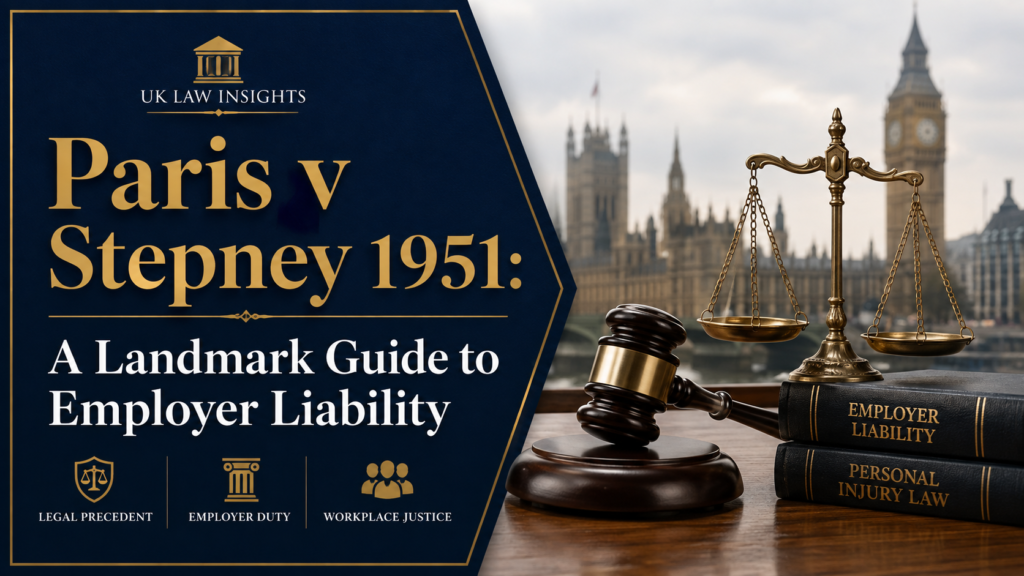
Paris v Stepney 1951: A Landmark Guide to Employer Liability
Paris v Stepney Borough Council [1951] AC 367 stands as one of the most important employer liability decisions the House of Lords has ever delivered. It furthermore actively established that an employer’s duty of care must take into account the specific vulnerabilities of each individual employee. Before this landmark ruling, employers could argue that a standard level of protection satisfied their legal obligations to every worker equally. The House of Lords consequently rejected this approach, holding that greater risk to an individual demands a correspondingly higher standard of care. At Dawn Solicitors we therefore actively use the principles established in Paris v Stepney 1951 to fight for injured and vulnerable workers across the UK.
Key areas explored in this article
- Paris v Stepney 1951: What Were the Facts?
- What Did the House of Lords Decide in Paris v Stepney 1951?
- What Legal Principle Did Paris v Stepney 1951 Establish?
- How Does Paris v Stepney 1951 Affect Workplace Injury Claims Today?
- How Dawn Solicitors Can Assist You.
- Conclusion.
- FAQs.
Paris v Stepney 1951: What Were the Facts?
The facts of Paris v Stepney 1951 are both straightforward and deeply compelling. Mr Paris was a mechanic employed by Stepney Borough Council, and his employer knew he had only one functioning eye. Whilst working underneath a vehicle, a metal chip flew into his good eye leaving him completely and permanently blind. The Council had not provided him with safety goggles despite knowing about his condition. Mr Paris therefore brought a negligence claim against his employer arguing that the Council’s failure to provide protective equipment constituted a breach of their duty of care. The case ultimately reached the House of Lords where their Lordships delivered a landmark and unanimous decision in his favour.
What Did the House of Lords Decide in Paris v Stepney 1951?
The House of Lords ruled decisively in favour of Mr Paris in Paris v Stepney 1951. Their Lordships furthermore held that the standard of care owed by an employer must be assessed by reference to the specific risk to the individual employee not just the general workforce. Therefore, because Mr Paris had only one functioning eye, the potential consequences of an eye injury were catastrophically greater for him than for a fully sighted colleague. The Council consequently owed him a higher duty of care, which required the provision of safety goggles even if they were not standard practice for other workers. Failing to provide this basic protection therefore constituted a clear breach of that duty resulting in full liability for his devastating injuries.

What Legal Principle Did Paris v Stepney 1951 Establish?
Paris v Stepney 1951 actively established the principle that the gravity of potential harm is a critical factor in assessing the standard of care an employer must provide. Therefore, where the consequences of an injury are disproportionately severe for a particular employee, the employer must take correspondingly greater precautions. Furthermore, this principle applies directly to employees with pre-existing conditions, disabilities, or vulnerabilities that make them more susceptible to serious harm. Additionally, the decision reinforced that employers cannot simply apply a one-size-fits-all approach to workplace safety. Consequently, Paris v Stepney 1951 remains the leading authority on individual risk assessment in employer duty of care cases across England and Wales today.
How Does Paris v Stepney 1951 Affect Workplace Injury Claims Today?
The principles established in Paris v Stepney 1951 continue to actively shape workplace injury claims involving vulnerable employees across the UK. Therefore, employers cannot simply argue that standard safety measures discharged their duty of care to every worker. Furthermore, employees with disabilities, pre-existing medical conditions, or known vulnerabilities can actively rely on Paris v Stepney 1951 to establish that a higher standard of care was owed to them specifically. Additionally, the decision furthermore supports claims where employers knew about an employee’s condition but failed to make appropriate adjustments or provide additional protection. Moreover, health and safety risk assessments must consequently take individual employee vulnerabilities into account not just general workplace risks. Therefore, any employer who fails to do so faces significantly stronger liability exposure in any resulting personal injury claim.
How Dawn Solicitors Can Assist You
Dawn Solicitors actively applies the principles of Paris v Stepney 1951 to fight for injured and vulnerable workers every single day. We therefore assess every workplace injury claim thoroughly identifying whether your employer failed to meet the higher standard of care your specific circumstances demanded. Furthermore, we gather occupational health records, risk assessments, and medical evidence to build the strongest possible case on your behalf. Consequently, you pursue your workplace injury claim with total confidence knowing every available legal argument is being actively and expertly deployed on your behalf.
To contact a solicitor from our firm, simply call us at +44 1753 530 111 or send us an email on info@dawnsolicitors.com
Conclusion
Paris v Stepney 1951 established that every employee deserves a standard of care tailored to their individual circumstances and therefore its legacy continues to protect vulnerable workers across the UK today. If your employer failed to account for your specific vulnerabilities and you suffered injury as a result, furthermore, you may have a powerful legal claim. Dawn Solicitors additionally fights for every injured worker with the expertise, determination, and compassion every client deserves. So contact our friendly team today for a confidential consultation and take the first step towards the justice you deserve.
FAQ's
Q1.Can I use Paris v Stepney 1951 principles if I have a pre-existing condition that made my workplace injury worse?
Yes, absolutely. Furthermore, the Paris v Stepney 1951 principles actively support claims where a pre-existing condition increased the severity of your injury. Therefore, your employer’s knowledge of your condition is a critical factor in assessing their liability. Dawn Solicitors consequently reviews every case individually to identify the strongest available legal arguments.
Q2. Does Paris v Stepney 1951 apply if my employer did not know about my vulnerability?
Employer knowledge is furthermore a key element of the Paris v Stepney 1951 principles. Therefore, where an employer was unaware of your condition, the standard of care assessment may differ. However, employers furthermore have a legal obligation to carry out thorough individual risk assessments which may have uncovered your vulnerability in any event. Dawn Solicitors consequently assesses every case carefully to determine what your employer knew or ought to have known.
Share :

Work With Our Experienced Legal Team
Join forces with our skilled legal team dedicated to providing expert advice and achieving successful results for every client.